Showing posts with label Haiti. Show all posts

Thursday, August 5, 2010

Toughest Job in the World?

Haitian Presidential Race Update

By Annie Fikes

Last week I blogged about the possibility of hip-hop star Wyclef Jean running for President in Haiti. I’m sure that everyone is on the edge of their seats, waiting to find out if this rapping philanthropist will make a bid for the presidency.

Wyclef Jean confirmed today that he will be running for president.

Jean is running as a candidate from the party Ansanm Nou Fo, a reformist party. Ansanm Nou Fo is a Creole name that comes from the French phrase “ensemble nous faut”, which means “we must (do it) together”. His campaign slogan is “Face à Face” (Face to Face), expressing his goal to create a more transparent system for Haiti’s government. Jean challenges the deep-seated corruption that plagues Port-au-Prince, claiming that “the old school will have to fall in line with the new model” and that government will be “conducted out in the open”. This will probably make him unpopular with existing Haitian leadership, but may help his credibility with the Haitian people, many of whom are disenchanted with the government.

Last week I couldn’t fathom what kind of political platform Jean would present. I wondered if he would rely on vague, idealist promises of rebuilding and reforming. However, Jean seems to have a more specific plan than I expected. He claims to draw much of his political philosophy from Bill Clinton. He wants to encourage cooperation between businesses, government, and civil society, an alliance that was beginning to see success before the earthquake. He wants to break up the power as well as the huge residential population in Port-au-Prince and spread it across the country. Jean also has mentioned a desire to rejuvenate rural communities and the agricultural sector through schools, clinics, and business.

Even before the earthquake ravaged the nation, Haitian presidencies were volatile at best. Haitian governments are habitually corrupted, inept, illegitimate, and unstable. Out of the past 53 Haitian leaders, only 9 completed their full term. 4 of those that did acted under U.S. occupation. 23 of the 53 were overthrown, 7 died in office, 7 only lasted a year or two, 2 were assassinated, 1 was executed, and 1 committed suicide. None of those presidents had to face a nation ravaged by an earthquake that killed a government estimated 300,000 people.

I wouldn’t expect people to be lining up for the job, but Jean faces dozens of competitors including his uncle, Raymond Joseph, the Haitian ambassador in Washington, and fellow Haitian musician Michel “Sweet Mickey” Martelly. Current president René Garcia Préval has not announced his endorsement yet, but it is unlikely to be Jean. All candidates must announce their bid to run by August 7th, and the election will take place on November 28th.

To read more about Jean’s presidency, follow this link: http://www.miamiherald.com/2010/08/05/1762628/its-official-wyclef-jean-to-run.html

Wednesday, August 4, 2010

Sustained Success in Haiti

by Aly Lewis

Since the terrible earthquake shook Haiti over six months ago, we’ve written a lot about Plant With Purpose’s relief and recovery efforts. We’ve been grateful to provide thousands of earthquake victims with jobs, food, tools, and seeds. As I look back over our accomplishments in Haiti over the last year, I am impressed with our tremendous relief efforts and achievements—employing over 2,100 people to plant over 170,000 trees and construct over 150 miles of soil erosion barriers—but I’m also struck by the success and achievements of our ongoing development efforts. In spite of the earthquake and the ensuing challenges, we were able to accomplish—and even surpass—most of our projected goals for the year alongside our relief program

For example, we have had an influx of farmers and community members who want to join in our reforestation efforts. New participants are asking to join our community groups because they have seen their friends and neighbors benefit from tree planting and soil conservation activities. Planting trees is one of the best ways for Haitian farmers to restore and replenish the degraded hillsides on which they live and farm. Between July 2009 and June 2010 we planned to plant 50,000 trees on deforested hillsides. Greatly exceeding our goal, we planted 88,196 trees, in addition to the 170,000 trees planted as a part of our “Cash for Work” emergency relief project!

Iloma Jean Baptiste, a member of our Cheridant group since 1998, said he has seen lots of benefits from planting trees in his own community. He said, “Trees we planted, for example these trees you see behind you, we now use to build our houses and make charcoal, and have made a good profit. We have done soil conservation to control erosion. The soil conservation work gives us a guarantee that we will not lose too much soil.”

Monday, August 2, 2010

Dreaming Together on the Border

by Aly Lewis

"When we are dreaming alone it is only a dream. When we are dreaming with others, it is the beginning of reality." ~Dom Helder Camara

Last week, Annie Fikes, our PR and Marketing Intern, blogged about the renewed hope and reconciliation that is taking place between Haitians and Dominicans as a result of Plant With Purpose's program on the border between Haiti and the Dominican Republic. This week I'd like to share a story about a Dominican farmer from the border region who is working--and dreaming--with Plant With Purpose to overcome poverty and build a better future for his family.

Antonio Guarionex Soto, a farmer from the village of Angel Feliz, is quite the innovator. With Plant With Purpose's encouragement, he continues to add new components to his agroforestry farm. He currently grows bananas, two types of avocados, zapote, oranges and beans. As a result of his agroforestry efforts, he has seen his soil quality and his crop yields improve. Avocado is by far his most successful crop because of the high demand for avocados in the region, and his farm is lush with the valuable fruit.

Antonio and his son, Jendis, show off one of their avocado trees.

Building on his success, Antonio would like to acquire more land in order to plant more fruit trees and see his business grow and thrive. His greatest dream is to provide better opportunities for his son so that he will not have to migrate to another region. As Antonio continues to improve and invest in his land, enabling him to enhance the quality of life of his entire family, we believe that he is well on his way to turning his dream into a reality.

Our innovative Trans Border Project has given hundreds of dedicated, hardworking farmers like Antonio the skills and resources needed to improve their farms, provide for their families, and realize their dreams for themselves and their children. Through Plant With Purpose's Sponsor A Village program, you too can dream together with rural farmers from around the globe and partner with them as they work to turn their dreams into a reality. To learn more, Click Here.

Above: a truck full of avocados makes its way to the local market. An abundant crop means farmers like Antonio can feed their families, improve their living conditions, and send their children to school.

Thursday, July 29, 2010

Wyclef for President?

By Annie Fikes

Yesterday, while searching the Internet for news about Haiti, I discovered that singer Wyclef Jean is seriously considering running for President of Haiti in the November election. He has not officially placed a bid, but he recently filed the necessary paperwork to run when the time comes.

At first, this struck me as a little ridiculous. As a native Californian, I’m no stranger to celebrity politicians, but the presidency? He’s a college drop-out, Grammy-winning, multi-platinum recording artist, and former Fugees member. He had a hit single my senior year of high school about a prostitute who used to be the “Sweetest Girl”. I’m guessing I’m not the only one who found the idea of Wyclef Jean the rap star running for the President of Haiti a little ridiculous.

However, there is more to Jean than his music career. He is the founder of the Yéle Haiti Foundation, which spreads global awareness about Haitian struggles, employs adults, sends children to school, and raises awareness about HIV/AIDS. Jean has remained committed to helping Haiti post-earthquake and serves as an ambassador-at-large under the current government. Wyclef Jean is passionate about the well-being of his country and optimistic about its potential for progress.

I have to confess.

I’m a total nerd when it comes to governments and politics.

I’m going to try to restrain myself and give you a bite-sized rundown of the Haitian government and presidency. The Haitian government has suffered from serious corruption and instability in the past, often greatly harming its people. Being the president in Haiti is similar to being the president in the United States, but not exactly the same. Haiti is a semi-presidential system, like France. This means that there is an elected president who shares executive power with a prime minister from the majority party in Parliament.

Haitian presidents are required to have lived in Haiti for five consecutive years, own property in Haiti, and have only ever been a citizen of Haiti. Wyclef Jean was born in Haiti and raised in the United States. I am unsure about Jean’s citizenship status; I have read that he remained a Haitian citizen his entire life, and that he is understood to be a U.S. citizen. He spends a lot of time in Haiti, and probably owns property there, but it is going to be difficult for him to prove five consecutive years of residency.

The implications of Jean’s presidential bid are vast. He is already famous and rich, so voters will trust that he is not running for personal gain. His fame and activist-image could bring higher voter participation than in past elections, particularly among young people. A celebrity president could keep media attention and foreign aid coming into Haiti long after it would have otherwise dwindled. His political inexperience could mean that he is outside the corruption that characterizes Haitian politics. However, It could also mean that he has no idea what he is doing and is unequipped to handle the slew of problems that face the future Haitian president.

I’m curious to see what will happen in Haiti. August 7th is the deadline to place a bid for the presidency, and other potential candidates have been reluctant to declare their intent to run. Jean may decide not to run, may not meet the necessary qualifications, or may turn out to be exactly what Haiti needs in a president. Whether or not that person is Wyclef Jean, electing the right president for Haiti will be an important step in continuing earthquake recovery efforts and stabilizing the nation.

Friday, July 23, 2010

Trans-border Tensions Between the DR and Haiti

By Annie Fikes

The relationship between Haiti and the Dominican Republic has been wrought with tension for hundreds of years. Haiti and the Dominican Republic, or the DR, as it is frequently called at Plant With Purpose, share the island of Hispaniola in the Caribbean. The French colonized Haiti and the Spanish colonized the Dominican Republic. At one point, after winning freedom from the French, Haiti occupied the entire island, forcing the Dominican Republic to fight for its freedom from Haiti.

Hope for a better future between the two countries has grown since the January earthquake in Haiti. The Dominican Republic responded better to the earthquake than anyone expected, providing swift, critical aid and efficient disaster relief to Haiti, greatly aiding in recovery.

However, as the DR is providing vital aid to earthquake victims, it made a constitutional change that prevents any DR-born child of undocumented workers from becoming citizens. The Dominican Republic is a wealthier nation than Haiti and many Haitians go there attempting to find work; almost all of them are undocumented. This change takes away citizenship from any child of immigrants who had it before the law passed, preventing them from acquiring a much-needed national I.D. This makes it difficult, if not impossible, for children of undocumented workers to get a college education, certain jobs, and passports.

Tensions between Haitians and Dominicans go beyond those caused by the recent constitutional change. Haitian immigrants in the DR have suffered lynching, murders, burned homes, and rampant racism, especially in the countryside along the border. This tension is the result of the struggle between Dominican farmers and Haitian immigrants who compete with them for land and economic space. Charcoal production, chopping trees and using a furnace to turn them into more efficient fuel, has long been a way for poor Haitians and Dominicans to make money. Charcoal production is extremely environmentally detrimental and is a huge cause of deforestation on Hispaniola. The DR banned the production of charcoal to protect its trees, but as forests in Haiti disappear, more desperate Haitians cross the border to participate in illegal charcoal trade in the DR. This damages the environment of the Dominican Republic and the relationship between the two nations.

Many Haitians cross into the Dominican Republic and become sharecroppers. Haitian work is cheap, so Dominican farmers hire them, but Haitian sharecroppers frequently return to their forest-clearing habits for charcoal production, extending Haiti’s ecological problem into the DR.

While the DR’s response to the earthquake may help the countries’ relationship, the disaster itself will further impoverish Haiti, driving even more undocumented workers who cannot become citizens into the DR, further damaging the environment.

Plant With Purpose is active in both Haiti and the Dominican Republic, often in conflict-heavy areas. Plant With Purpose attempts to ease the tensions between Haitians and Dominicans through our trans-border project by finding alternative employment for Haitians so they don’t become sharecroppers or participate in the charcoal trade. Plant With Purpose reforests areas that have been cleared by the charcoal trade and teaches sustainable agriculture to farmers on both sides of the border, helping them to heal their environment. By emphasizing God’s love for His people and the planet, Plant With Purpose hopes to foster a mutual respect between Haitians and Dominicans and a care for the environment. Creating jobs for Haitians, helping plant trees, and encouraging environmentally friendly land use will help eliminate many of the causes of violence and tension between Haiti and the Dominican Republic.

For more on the relationship between the Dominican Republic and Haiti, see this article: http://www.miamiherald.com/2010/07/16/1734536_p3/six-months-after-the-earthquake.html or read Scott’s book Tending to Eden!

Tuesday, July 13, 2010

Plant With Purpose's Work in Haiti Featured in the New York Times

News about Haiti resurfaced in the media yesterday, July 12th, which marked the 6 month anniversary of the tragic earthquake. People blogged, reported, and Tweeted about what has been done to help Haiti since that fateful day. Our work in Haiti, including the progress we have made and the steps we are taking to protect Haitian farmers against potentially deadly hurricane storms, was featured yesterday in the New York Times. Here is a brief excerpt:

"Sabin's organization has so far hired some 2,200 workers to plant more than 170,000 trees to protect communities. The extra available labor has allowed him to scale up Plant With Purpose's operations, constructing more than 260 miles of soil erosion barriers to protect farmland from hurricanes and tropical storms."

Click here to read the full article "Devastated Haiti Braces for an Active Hurricane Season":

http://www.nytimes.com/gwire/2010/07/12/12greenwire-devastated-haiti-braces-for-an-active-hurrican-11849.html?pagewanted=1

Monday, July 12, 2010

Haiti 6 Months Later: "Haiti is on its knees, but not down yet"

Today marks 6 months since the devastating earthquake in Haiti. Although there is still much to be done, the communities Plant With Purpose works with have made significant progress by planting trees, constructing soil conservation barriers, and providing incomes to support their families through our “Cash for Work” program.

Below is a firsthand account about the situation in Haiti from Plant With Purpose Technical Director Bob Morikawa who spent a total of six weeks in Haiti over a four month period after the earthquake and is returning next week to continue to work with our local Haitian staff to continue their relief and development efforts.

“It has now been six months to the day since the earthquake in Haiti which triggered one of the worst humanitarian disasters in recent history and also one of the largest relief responses ever seen. I myself arrived in Haiti on January 24th, crossing overland through the border between the Dominican Republic and Haiti since the Port au Prince airport was closed to commercial flights at the time. I found a country devastated as we have all come to know through the extensive coverage on the news and in social media. I also found many people hard at work, throwing all their energy into the immense task of bringing relief and shelter to the hundreds of thousands affected by the quake. I was very encouraged to find, first of all that none of our local staff were lost (one of our technicians tragically lost his wife and child), and second that our local staff were hard at work as well, organizing work teams to clear debris from the local feeder road, and making initial efforts to distribute water and supplies. Over the days and months to come, we and many other organizations were able to rapidly scale up our efforts, to meet the needs of many victims. The scale of the need was mind boggling, and although even our small organization was able to provide seeds, food, tools and employment to thousands, it never seemed like enough. Fortunately, we have come through a successful cropping season which has stabilized the food security situation somewhat, and thanks to the efforts of many NGO's at least temporary shelter has been provided for many. There are still thousands who find themselves essentially homeless, or in very vulnerable quarters and we can only hope for a mild hurricane season which would buy us all more time to improve recovery efforts.

Speaking from our own experience in the communities where we directly work, we found that the initial quake created an extremely fluid situation where many people from urban areas fled to rural zones (where we work) to take shelter with their relatives. This put an immense burden on already poor rural families and boosted family size from 6 or 7 members up to 10 or 12 members. Meals per day dropped to just one or less in many cases. Now, according to surveys we have conducted, many of those additional family members have returned to the city, and most families are eating 2 or more meals per day. This is still not back to pre-quake levels, but at least the trend is in the right direction. Now our efforts as an organization, and those of many organizations are shifting focus from immediate relief and instead we are putting our efforts into helping families make the transition to a more stable situation where food supply is secure, and income is reliable. In rural areas, this will involve such interventions as tree planting and soil conservation to stabilize farm fields, and income generating projects such as poultry and goat production. We will also continue--as we did before the earthquake--to work with community groups to help strengthen local leadership, and improve a community's ability to mobilize savings, and deal with their own economic issues. In fact we found that this was a distinct advantage for us because those relationships and the leadership built up prior to January 12th enabled both our organization and communities to respond more rapidly and with greater order and precision than would have been possible otherwise.

Take a moment to consider the resilience of Nelta Fils-Aime, who was displaced from Port-au-Prince where she worked and lived with her 5 siblings. She has since returned to the countryside with her siblings to live with her father. She is not a member of Plant With Purpose’s programs but her father is. Through the soil conservation work provided by Plant With Purpose she has been able to contribute to her household. She has no plans to return to Port-au-Prince for now but says she is grateful for the opportunity to make some money for her family. Everyone refers to her as very courageous, because the work she does, she does with only one hand. She is uncertain of what will happen next, but says she would like to start her little business and stay in the countryside.

The work is far from over. Haiti was one of the poorest countries in the world even before January 12th, and I had always thought that people were living on the edge. It turns out that now that 'edge' has been moved to a place I simply would never have imagined. It is surely a testament to the resilience of the people of Haiti, and as a locally popular song inspired by these events says "Haiti is on its knees, but not down yet."

~~~~~

Since the earthquake, Plant With Purpose has provided 125 tons of food to 15,000 Haitians, distributed nearly 80,000 pounds of bean seed to over 2,000 families, and employed over 2,000 farmers through our “Cash for Work” program. Additionally, farmers have constructed over 260 miles of soil conservation barriers and planted over 170,000 trees. The “Cash for Work” programs are allowing people like Nelta to stabilize and contribute income to support their families.

Plant With Purpose has raised nearly $1 million to support all of our Haiti relief efforts, and part of that support has been provided by partner companies of 1% for the Planet, a non-profit that blogged about our work in Haiti last February (click here to read that blog.) 1% for the Planet has blogged about our work in Haiti again today, which you can read here: http://onepercentfortheplanet.org/blog/

Plant With Purpose has responded to the immediate and interim needs in Haiti where we have built long-standing relationships over the last 13 years. Please consider partnering with us as we continue our long-term recovery efforts in Haiti. To make a donation, you can visit our website, www.plantwithpurpose.org. You can also subscribe to our blog to receive updates on our work in Haiti at www.plantwithpurpose.blogspot.com.

Friday, July 9, 2010

How Plant With Purpose Helps Farmers "Produce" through Empowerment

By Annie Fikes, PR and Events Intern

I’m not “outdoorsy” by any stretch of the imagination. I love wandering around in forests, playing sports, taking nature walks, and going to the beach, but it would take a superhuman amount of persuading to get me into anywhere near a week-long backpacking trip or a mountain climbing harness. When I left my native San Diego for college in Seattle last September, I entered the land of Birkenstocks, Northface parkas, hiking, snowboarding, skiing, snowshoeing, kayaking, and weekend backpacking trips.

At least three of my friends keep full mountain climbing gear in their dorms and scurry off to scale cliffs every chance they get. I, on the other hand, am still physically and emotionally scarred from my first and last attempt at mountain biking.

I never expected to participate in any “Outdoor Adventure” and “Recreation Program” trips until I saw the flyer for a day trip to a local farm. Off I went to work on a biodynamic farm on the first truly gloriously sunny day of spring. It was blissfully un-extreme. I escaped from the city to a gorgeous valley where I got to sit barefoot in the dirt, planting broccoli and kohlrabi and learning about sustainable agriculture from a philosophy professor-turned farmer.

Biodynamic farming is based on the idea that soil and the farm are living organisms. Biodynamic farms attempt to be entirely self-sustainable and individual, striving to break free from the massive, environmentally detrimental farms that dominate American food markets. Biodynamic farms try to preserve soil quality for future generations, provide produce to their local area, make their own fertilizers and composts, and always avoid pesticides.

I left Jubilee Farms covered in dirt and sweat and enlightened by new ideas. I couldn’t help but think about what I learned there when I read about the GMO corn and tomato seeds that an American company, Monsanto, attempted to donate to farmers in Haiti. Monsanto’s seeds were treated with fungicides deemed so dangerous by the EPA that American agricultural workers must wear mandatory protective gear when handling them.

Haitians are extremely angry about the introduction of these foreign and dangerously treated seeds into their market. A group of Haitian farmers, the Peasant Movement of Papay, has been leading demonstrations against Monsanto and burning the donated seeds. Haitians, like biodynamic farmers in America, want to protect the integrity of their local markets, agriculture, small farmers, and environment. One farmer, Jonas Deronzil, said, “People in the U.S. need to help us produce, not give us food and seeds. They’re ruining our chance to support ourselves.”

Plant With Purpose strives to help people “produce” when it empowers local farmers in the countries that it works in to farm their own food in ways that will protect their local environment. When I work with Plant With Purpose I do it from a desk, but I feel like my opportunity to get out into nature at Jubilee Farms gives a little bit of an understanding of what Plant With Purpose is really about and the amazing relationship that people can have with the planet.

To read more about Monsanto seeds in Haiti, check out this article: http://www.foodsafetynews.com/2010/06/haitian-farmers-burn-monsanto-hybrid-seeds/

Thursday, June 10, 2010

You’re Invited!

Are you interested in learning more about our recovery efforts in Haiti? If so, Plant With Purpose would like to invite you to attend a Haiti Recovery Update Conference Call hosted by Scott Sabin, Executive Director of Plant With Purpose, on Tuesday, June 15th, at Noon PST / 3:00 p.m. EST.

As we approach the 5 month anniversary of the tragic earthquake in Haiti, Plant With Purpose remains dedicated to helping the 67 villages where we work in long-term recovery efforts. As you know, though historically a sustainable development organization, we have expanded our post-earthquake role in Haiti to include aid efforts that promote long-term growth and prosperity, including our Cash for Work program and food and seed distribution. Since January 12th, we've raised nearly $1 million to help in these efforts thanks to your support!

This brief call will include:

• an overview of our long-term recovery programs

• an update on our progress

• our strategy for preparing for the hurricane season

• information on how you can get more involved

• a chance for you to ask questions during a Q & A

This call is a great way to remain in the loop and stay connected to our vital work in Haiti. Although this call is telephone based only, you can still view photos of our work in Haiti by becoming our fan on Facebook, finding the “Haiti Recovery Call” photo album, and following along during the presentation.

Please click here to register. You will then receive the dial in information via email.

The first 30 people to sign up for this call will receive a free copy of Scott's new book, Tending to Eden: Environmental Stewardship for God's People! Click here to learn more about this book.

We hope you can join us on this important call!

-The Plant With Purpose Staff

Tuesday, June 1, 2010

Plant With Purpose Helps Haitians Prepare for Hurricane Season

by Kate McElhinney

Today marks the official start of hurricane season in the Caribbean. Unfortunately, this season is predicted to be one of the wettest on record according to the U.S. National Oceanic and Atmospheric Administration, which estimates that as many as 23 tropical storms will hit the Caribbean this year. Tropical Storm Agatha already ravaged parts of Central America last weekend, and more storms are predicted to be brewing.

For the hundreds of thousands of Haitian earthquake victims, hurricane season looms as another treacherous obstacle. Many only have tarps or fraying tents to protect them in a major storm, and eroded hillsides threaten to become deadly mudslides when provoked by heavy rains.

Despite this grim prediction, Plant With Purpose remains dedicated to helping rural farmers to prepare for the rainy season. Our Haitian staff were on the ground in Haiti at the time of the earthquake and were able to respond immediately to the crisis. Though historically a sustainable development organization, we have expanded our post-earthquake role in Haiti to include aid efforts that promote long-term growth and prosperity, including our “Cash for Work” program and food and seed distribution. Since January 12th, we've raised nearly $1 million to help in these efforts.

Here are some quick statistics of our progress since January 12th:

-136,868 trees planted

-2,120 people employed through our “Cash for Work” program

-nearly 80,000 lbs. of bean seed distributed

-nearly 250,000 lbs. of rice distributed

-over 4 miles of road repaired

By employing local farmers, distributing food, and planting trees Plant With Purpose is supplying farmers with the tools and the knowledge they need to get back on their feet and replant and reforest their land before the hurricane season gets under way. Some farmers have already harvested bean crops, which provide nutritious food for their families as well as a valuable product to sell at the market.

Stay tuned for more updates on Haiti, and if you would like to help or learn more please visit: www.plantwithpurpose.org.

Kate McElhinney serves as the Marketing Coordinator for Plant With Purpose. She plays an integral role in executing the company’s marketing campaigns and PR efforts. Kate also coordinates the annual gala and oversees the production of the company newsletter, The Sower.

Friday, May 28, 2010

Voices from Haiti

Plant With Purpose is responding to the catastrophic earthquake of January 12th with a relief and recovery project that is helping Haitians get back on their feet and giving them hope for the future. Plant With Purpose is providing emergency relief to victims and their families through road clearing, food and seed distribution, and a short-term employment project.

Edzer (not pictured) is a farmer from the Bwanef group who has benefitted from Plant With Purpose’s soil conservation program. He has worked with Plant With Purpose since 1997, and he says that the group has helped him with a lot of things. They have showed him how to protect his land with ramps, soil conservation, and many other techniques, as well as how to plant trees and create nurseries.

Following the January 12th earthquake, Edzer became involved in Plant With Purpose’s “Cash for Work” program. With the cash he is making from this program, he said he is able to get a bit of food to feed his family. Edzer says that planting trees and protecting the land is the most important thing he can do following the earthquake. In February he was given bean seed to plant, and he is already starting to see the first harvest!

“For those who support Plant With Purpose, I want to say a big thank you,” said Edzer. “I don’t know what will happen next, but we are waiting on God and we are thankful for all he has provided for us so far. Things could have been a lot worse for us.”

Three Ways you can Help Haiti:

>Pray that Plant With Purpose will be able to give an appropriate response to the needs of the victims of the earthquake, and for protection against any perils the rainy season may bring.

>Sponsor a Village in Haiti and help transform an entire rural community by empowering them to create economic opportunity and to protect their greatest asset, the land.

>Give to long-term Haiti recovery efforts at www.plantwithpurpose.org.

More voices...

Desire Toussaint'mem of the Davi group sells lotto tickets to support himself. Generally the lotto owner gives him 50 gourdes on every 500 gourdes he sells per day (500 Haitian gourdes=$12.42 US dollars.)

Madam Rigaud Pierre Louis is a farmer in Koray, Haiti who has benefited from Plant With Purpose’s soil conservation program. She also runs a business selling soap, notebooks, cream, and other products. Here, a client visits Madam Riguad at her business in the Blokos Market.

Friday, May 14, 2010

A Visit to Fonds-Verrettes, Haiti

By Kathie Culhane-Pera, MD

The below article was written by a member of St Clement’s Episcopal Church in St. Paul, Minnesota. St. Clements sponsors the village of Fonds-Verrettes, which is a part of Plant With Purpose’s Floresta-Haiti program, and Kathleen had the opportunity to visit that village on a recent trip. Here are some of her experiences.

I have just returned from Haiti where I worked as a medical volunteer at Leogane. Because our church congregation has joined funds to support Plant With Purpose’s community and agricultural development program in Fonds-Verrettes, I also visited Fonds-Verrettes.

I saw evidence that Floresta-Haiti is making a significant impact on people’s lives in Fonds-Verrettes. I met farmers in a field as they were planting trees and in a church building. I was able to hear some of their stories—and their testimonies about the importance of Floresta-Haiti in their lives. They said:

“M’aime Floresta. I love Floresta.”

“Floresta es m’manman, m’papa. Floresta is my mother and my father.”

“Floresta does not give me things, but has taught me to do for myself.”

“Floresta has taught me how to compost, how to increase the yield of my soil.”

“Floresta has taught me how to plant with natural fertilizers, graft trees, and raise goats.”

“Floresta has taught us to conserve our soil and decrease our erosion.”

“Floresta has taught us how to pool our money, and loan it to each other.”

“Floresta has permitted us to be a big family of 10 villages, united in preserving the land.”

“Floresta helps us partner together.”

One man quoted a Haitian proverb: “Men anpil chay pa lou. Many hands, the load is not heavy.”

Another man quoted a different Haitian proverb that supports this same idea:

“Yen sel dwet pa manje kalalou. Yen sel nou feb ansanm nou fo.

One digit alone cannot eat ochre. We alone are weak, together we are strong.”

Indeed, Floresta-Haiti and the people of Fonds-Verrettes are doing God’s work. But they cannot do it alone. The congregation at St Clement’s Episcopal Church in St Paul MN is committed to supporting them in their work. Together, we know we can do great things.

If you or your church are interested in sponsoring a village in Haiti, please click here to learn more.

Friday, May 7, 2010

The Strength of a Community

By Tenaya Wickstrand, Plant With Purpose PR Intern

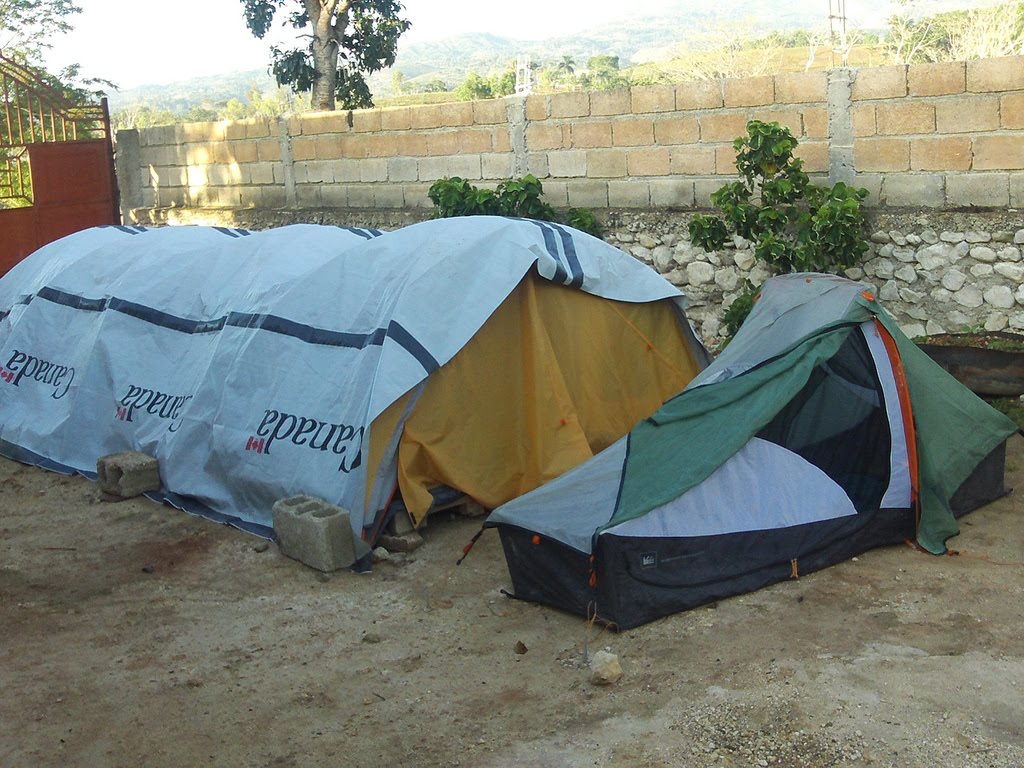
When our Executive Director, Scott Sabin, arrived at one of our program sites during his recent visit to Haiti, he noticed that our staff had taken makeshift tents and joined them together in order to make one long tent. This seemed to be a natural thing for them to do, as they didn’t want to be separated or to sleep alone; they created a place for everyone to sleep together with the security of being a community.

Another example of the Haitian’s interpersonal closeness, as Scott expressed, is that when people stand in line, they are so close they’re basically touching one another. This was amazing to me. I can’t imagine being in line and having the person behind me touching me, let alone me being that close to the person in front. Our culture has a different acceptable level of personal space; I’m sure I'm not alone in that feeling. But I was fascinated by how united the Haitians are, and I have to say that I do think we lack a bit of those community ties here in the United States.

In California, especially, we are private people. There is an unspoken need for individual space and privacy. People will even choose an isolated seat to avoid sitting right next to another person in a movie theatre, a restaurant, or elsewhere. We even protect our personal privacy with laws.

As Haiti exemplifies, this privacy tendency we share in the United States is not shared in other parts of the world. In 2008 I studied abroad in Italy and had a glimpse of how close everyone is in the Italian culture. I was in a “ristorante” one night observing the way the hostess seated customers and noticing how very different it was from home; I asked our server about it. He told me that in a restaurant in Italy people are seated in tables right next to each other, even if the entire place is empty. This was because Italians like feeling related to one another, even in a restaurant with people they don’t know. This stood in stark contrast to the American way where the two tables of people would have been seated as far apart as possible.

This connection the people of Haiti have has helped them in dealing with the aftermath of the earthquake. A recent LA Times article explains that, "Haitians rely on their communities to survive. They borrow money from neighbors, share food, watch one another's children, and sell things they pick up in the central markets."

Plant With Purpose is connected with Haiti and the communities where we have programs. I think we can apply this feeling of being part of a family to our work everywhere. The closeness of the connection helps us understand other people's ways of life and to realize the group mentality they have can be quite an asset. At Plant With Purpose, we talk about involving ourselves and understanding the way each community operates. In order to achieve this, we need to strip ourselves of our individualistic mindset and be open to sharing and connecting with the people and countries where we work.

Plant With Purpose seeks to do just that. In Haiti we work side by side with the local farmers. We get to know them as individuals but also as a part of their community. This direct involvement has aided our success in Haiti and the many other countries where we operate. We teach them, but they also teach us.

Thursday, April 29, 2010

Plant With Purpose in Relevant Magazine!

Check out Plant With Purpose in the May / June issue of Relevant magazine and find out why caring for the environment will be key to Haiti's recovery: http://www.relevantmagazine.com/digital-issue-45?page=83

Please help us spread the word about our work in Haiti by adding this link on your Twitter or Facebook page!

Also, check out this review of Tending to Eden on Relevant's online Creation Care section: http://www.relevantmagazine.com/creation-care/features/20905-planting-with-purpose

Happy reading:)

Monday, April 19, 2010

What does it mean to “Tend to Eden”?

By Kate McElhinney

Want to learn more about what the Bible has to say about caring for the environment? Or maybe you’re wondering how the environment impacts the lives of the poor. Plant With Purpose’s Executive Director, Scott Sabin, has recently written a book that answers these questions, and more.

Here is a sneak peek from pages 22 to 24 in Tending to Eden: Environmental Stewardship for God's People.

“In December 1997 Plant With Purpose’s technical director, Bob Morikawa, and our new Haitian director, Jean-Mari Desilus(whom we called Dezo), traveled with me to the Haitian village ofKavanac. The sun beat down on us as we walked a steep, narrow path between hillside farms, their tiny fields separated from one

another by loose rock walls. Ragged corn struggled through the rocks on either side of us. My lunch was not sitting well.

After we’d crossed one ridge and were on our way up a secondlong slope, I told the others I needed a rest. As I sat on a large stone, contemplating the hill in front of me, two elderly women came up the hill, five-gallon buckets of water balanced on their heads. “Bon swa, blan,” they greeted me. They asked where we

were going, and Dezo told them we were headed to a village meeting in Kavanac. The older woman said they were on their way to the same meeting. “We’ll let them know you will be along in a

while,” she said with a teasing grin.

At the top of the last ridge, I could see the Caribbean to the south, Haiti’s tallest mountain, Pic La Selle, shrouded in cloudsto the east, and the brilliant blue water of the Bay of Port-au-Prince to the north. A little farther along the ridge sat a group ofabout forty farmers, men and women, in an open-sided lean-to

made of wood and corrugated tin. When we reached them, several sidled up tome and discreetly held out their hands while rubbing their stomachs.

I shook my head, indicating I had nothing to give them. The meeting convened and moved past pleasantries to a series of questions from the community as to what Plant With Purpose intended to do in the village. A woman stood and, in a confrontational tone, told me about the other humanitarian agencies that

had worked in the area. She named two agencies that had brought food and clothes, then left and never returned. “How is Plant With Purpose going to be any different?”

After giving the question some consideration, I responded, “Well, first of all, we are not going to give you anything.” She looked stunned.

“Second, we are not going to leave until you ask us to.” The woman stood there, speechless.

Once we understand God’s heart for justice and the vicious cycle of deforestation and poverty that traps the poor, how do we respond? The desire to help is admirable in a world where far too many pass by on the other side of the road. But determining how to respond can be complicated.

I was originally drawn to the work of serving the poor and hungry because it seemed simple, unambiguous, and virtuous. I had studied political science and was often struck by the moral ambiguity and unexpected consequences of most policy choices. Well intended programs often had the opposite effect of what their

drafters expected. The most well-meaning projects could cause great harm. As I was to discover, humanitarian work can be nearly as complicated.

Many humanitarian organizations respond to poverty and injustice by giving surplus food, medicine, and clothes, and maybe starting orphanages and clinics. They focus on treating the symptoms of poverty—which sorely need to be treated. But others ask questions about the root causes: Why are people are hungry and sick? Why so many orphaned children?

The Bible seems pretty straightforward in its approach: give a cup of cold water in the name of the Lord. Our first response is often to give things away. The poor clearly lack things, and we have things, so what could be more obvious than giving out of our abundance?

Yet giving things often comes with unintended consequences. Without knowing the needs and challenges faced by local communities, our gifts can be inappropriate. In one community where we work, a relatively new bulldozer sat in front of a school yard for many years, slowly rusting. No doubt it was given with the

best of intentions and was probably very expensive to ship. Yet it was completely inappropriate to the local conditions. It ended up serving as a germination bed for weeds and a few small trees before being sold for scrap.

Even when gifts are appropriate to the needs of the people, they can often create dependency. Haiti has received numerous donations and many short-term mission teams have come to share the gospel and build churches and school buildings. Yet there is a growing school of thought that much of our aid may be hurting the locals.

As we were establishing Plant With Purpose in Haiti, a longtime missionary sternly informed us that he wasn’t sure Haiti needed another well-intended nonprofit agency. “We have created a nation of beggars,” he said. “For years folks have been coming down here thinking they are helping by giving things away. But that just teaches people to beg.” Another missionary told me that after citizens in one village received cracked wheat from USAID, few local farmers bothered to plant corn because they couldn’t compete with free food.

Often, the problem is less with aid itself than with how it is applied. We tend to focus on short-term, immediate-impact solutions rather than long-term investments in people. Many Americans have at least a passing understanding of what handouts do to initiative, self-esteem, and motivation. We talk of how a welfare mentality creates dependency. When we see panhandlers on the street corner, most of us realize a handout won’t change their lives. A gospel tract probably won’t do much good, either—though it may be better than handing them a dollar. Unfortunately, we don’t always translate that understanding into our approach to the poor overseas.”

You can purchase Tending to Eden through our website here: http://www.plantwithpurpose.org/page/64/tending-to-eden.html.

For every purchase that is made through our website, amazon.com will donate a portion of the proceeds to Plant With Purpose, which will go toward directly benefiting the rural poor. Thank you, faithful readers, for your support! And stay tuned for more "tastes" of Tending to Eden.

Kate McElhinney serves as the Marketing Coordinator for Plant With Purpose. She plays an integral role in executing the company’s marketing campaigns and PR efforts. Kate also coordinates the annual gala and oversees the production of the company newsletter, The Sower.